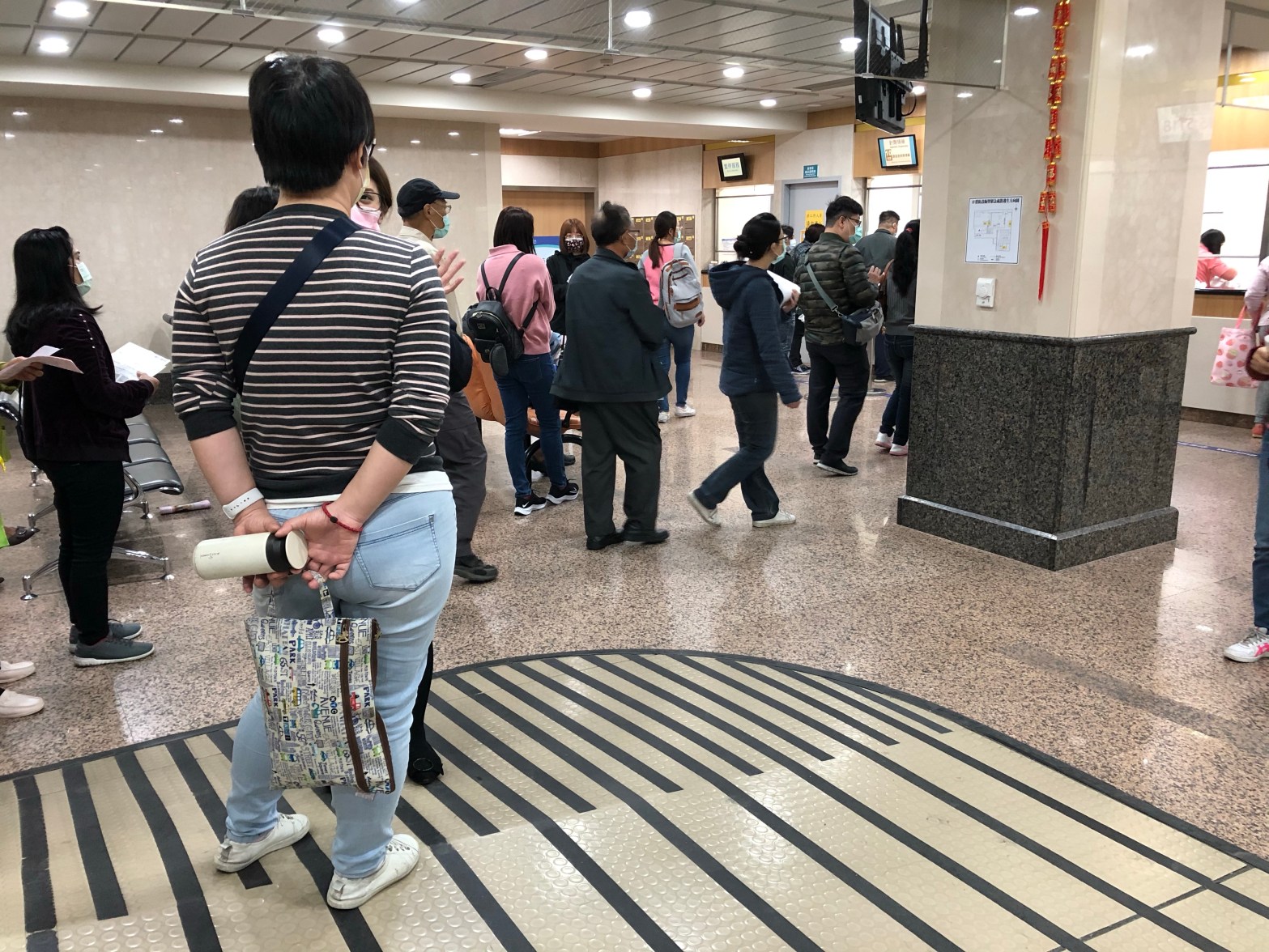
Taiwan is one of the safest places to be during this current global pandemic. It is in large part due to the country’s robust universal single-payer healthcare system. One of the frequently cited reasons for Taiwan’s success is the fact they were able to quickly identify potential Covid cases through the national patient database because it was centralized.
I think people have preconceptions of what universal healthcare means from a purely Western perspective, often citing the Canadian or European systems, but few ever mention Taiwan’s system, even though it’s been in effect for over 25 years with virtually everyone covered and with high satisfaction.
I have been accompanying my parents on their medical visits to understand better how universal healthcare can work. The U.S. National Institute of Health characterize the Taiwan system as “good accessibility, comprehensive population coverage, short waiting times, relatively low costs and a national health insurance databank for planning, monitoring and evaluating health services. ” Of course there are certain drawbacks, such as overworked doctors and a nursing shortage, but the overall NHI system continues to evolve to address issues as they arise. Here I want to highlight the remarkable benefits of the system based on my parents’ experiences and contrast them to their care in the U.S.
- Good accessibility means my parents are able to get an appointment with any specialist, either at hospitals or private clinics, within 1-3 weeks, especially if they were referred by another doctor, but not required. They have not had to wait longer than that. The hospitals and clinics can be private or non-profit entities or are run by municipal governments.
- The NHI covers not only medical but also dental and eastern medicine remedies too (e.g. acupuncture).
- Comprehensive population coverage literally means everyone in the country is covered, even non-citizens who are residing or working in the country. My family and I are eligible after 6 months of residence. My parents are part-time residents of Taiwan but they are eligible for full coverage as long as they continue to pay for the monthly premium, which is minimal (under US$30 per month)
- When my parents arrive for appointments, they are generally seen within 30 minutes of their scheduled time slot. Appointments and surgeries are also scheduled within 1-3 weeks of request.
- The premiums are equivalent to 5.7% of a person’s salary but the portion the person pays depends on the employment category they fall into, which means it is often only a portion of 5.7%.
- There are NO deductibles and each visit has a set co-pay that is billed to the patient as soon as the visit is over. The copays amount to less than US$20 depending on the service. Surgeries are more but are on the order of hundreds to thousands of dollars (US$), not tens or hundreds of thousands.
- As a single-payer system, the NHI manages to negotiate the cost of medication for the entire country with pharmaceutical companies, helping to lower and fix drug costs. What the patient pays is orders of magnitude lower than in the U.S.
- The NHI database is tied to each individual’s NHI card and is remarkable in its simple efficiency. It helps to keep administrative costs down to 1% of the health care budget compared to 12%-25% of U.S. health care systems.
- Additional in-home assistance is provided to elderly and handicapped to support and help provide complete care, which includes house cleaning, cooking, organizing holistic care and medication administration. All of this is covered under the NHI.
NHI Card
The most notable and impressive of all the benefits is the fact that their entire health record can be accessed with their insurance card. This simple chipped card allows all providers to be able to access the patient’s full medical history and medications. This includes dental care as well.
In contrast, in the U.S., we have to sign papers to transfer records from doctor to doctor and fill out paperwork reporting our health history to every new doctor we see. Furthermore, it’s never clear whether all of our information is completely transferred. Worse than that, the doctors rely on patients to tell them what medications they are on. For older people, they may be on multiple medications and cannot realistically be expected to track all of the pharmaceutical names they are taking.
I took my dad to a walk-in clinic in the U.S. once that was affiliated with his care provider, but they were not able to tell us if the medications they were prescribing would have negative interactions with his current medications because they had no visibility into what his current medications were. He, of course, had no idea what his medications were. They simply said the pharmacist would let us know, which seems to push off the responsibility and would be problematic if they switched pharmacies.
Also, the card is used with automated machines for checking-in and payments. It helps minimize extensive administrative costs related to paperwork and payments. Apparently, this NHI card system means administrative costs are only 1% of the healthcare costs for the country compared to 12%-25% in the U.S. Here, they simply plug their card into a machine. Even my parents who are technology averse can handle it.
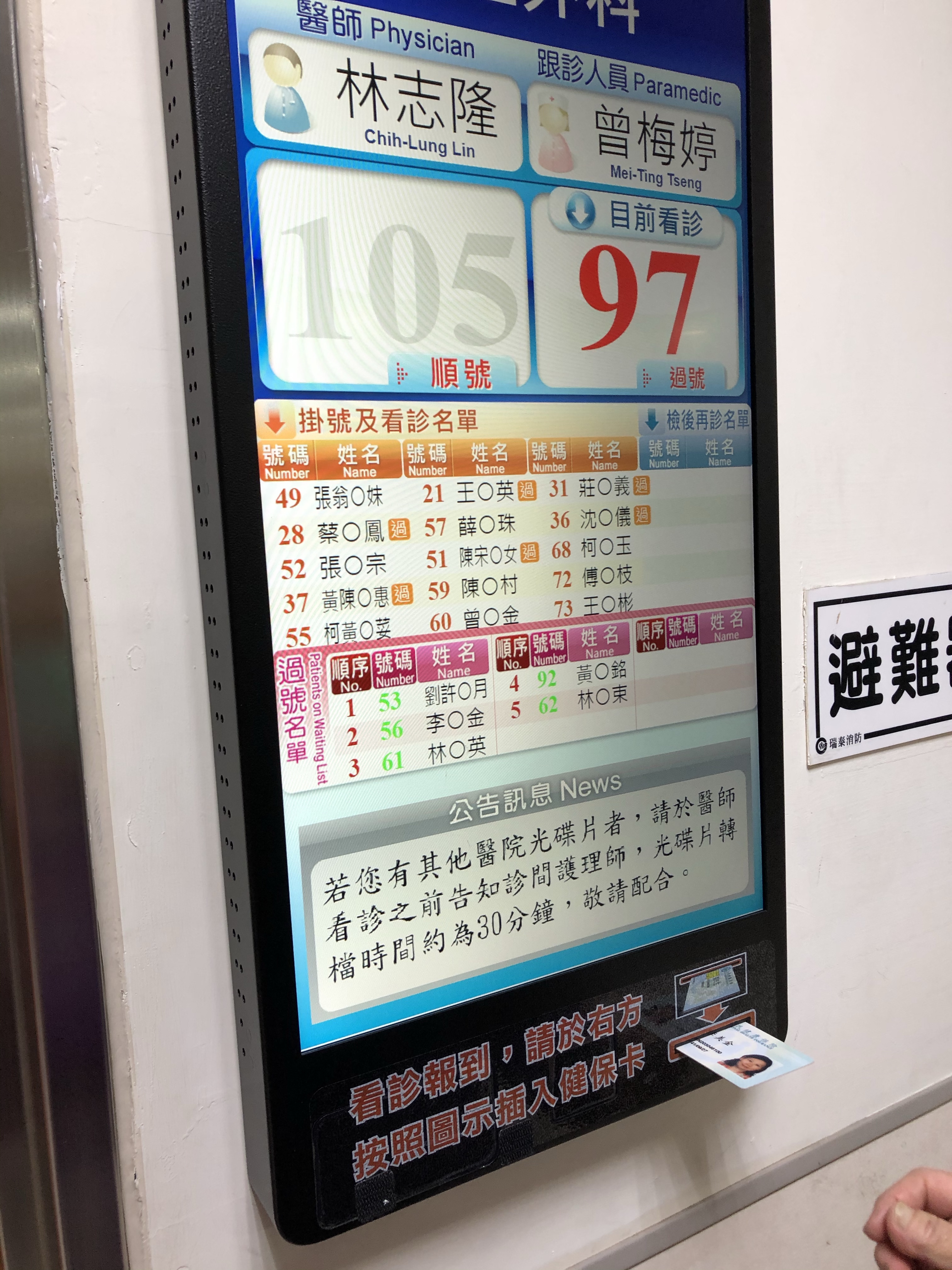
Stick chipped card in machine to check in. 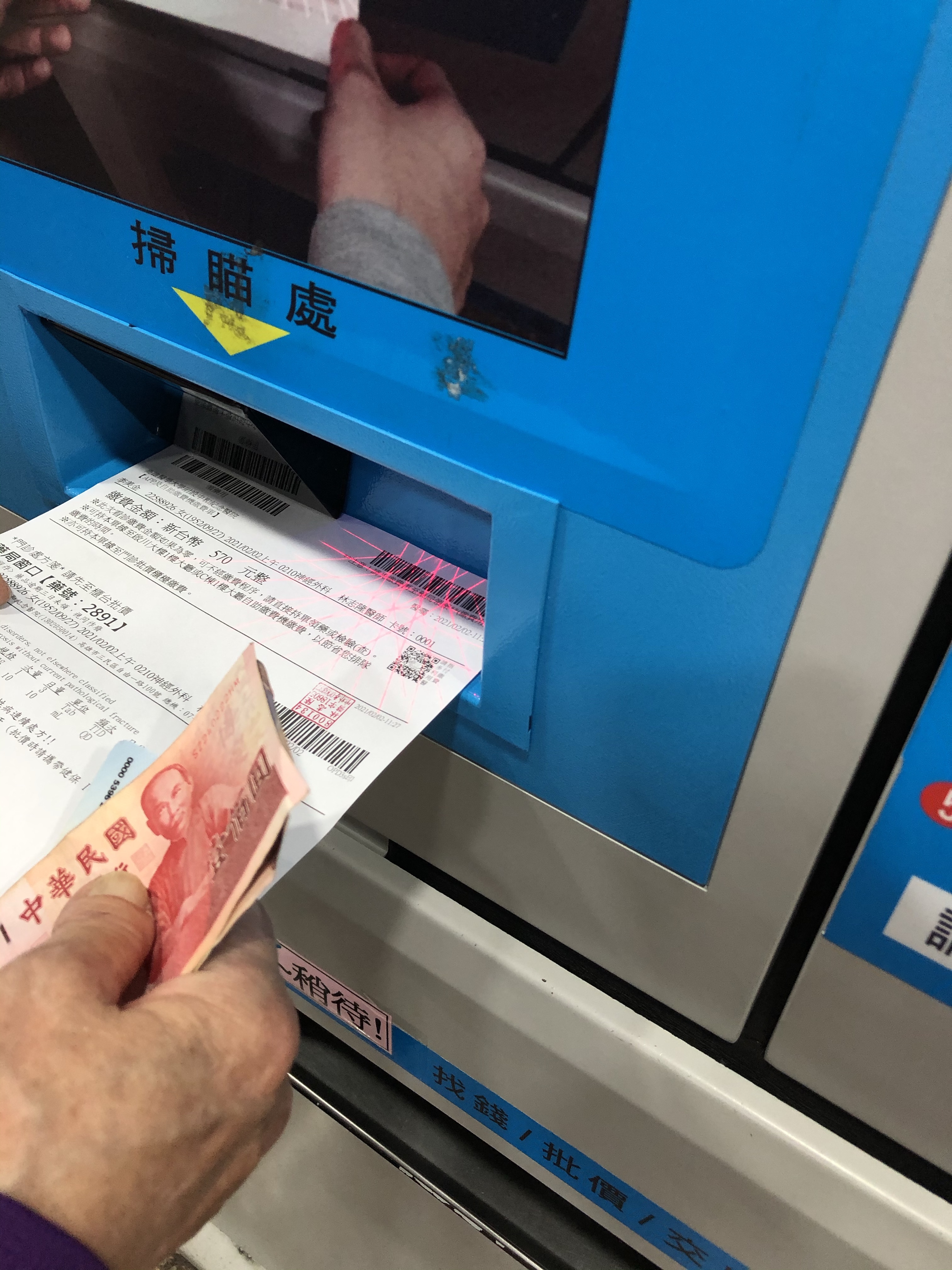
Scan bill for payment 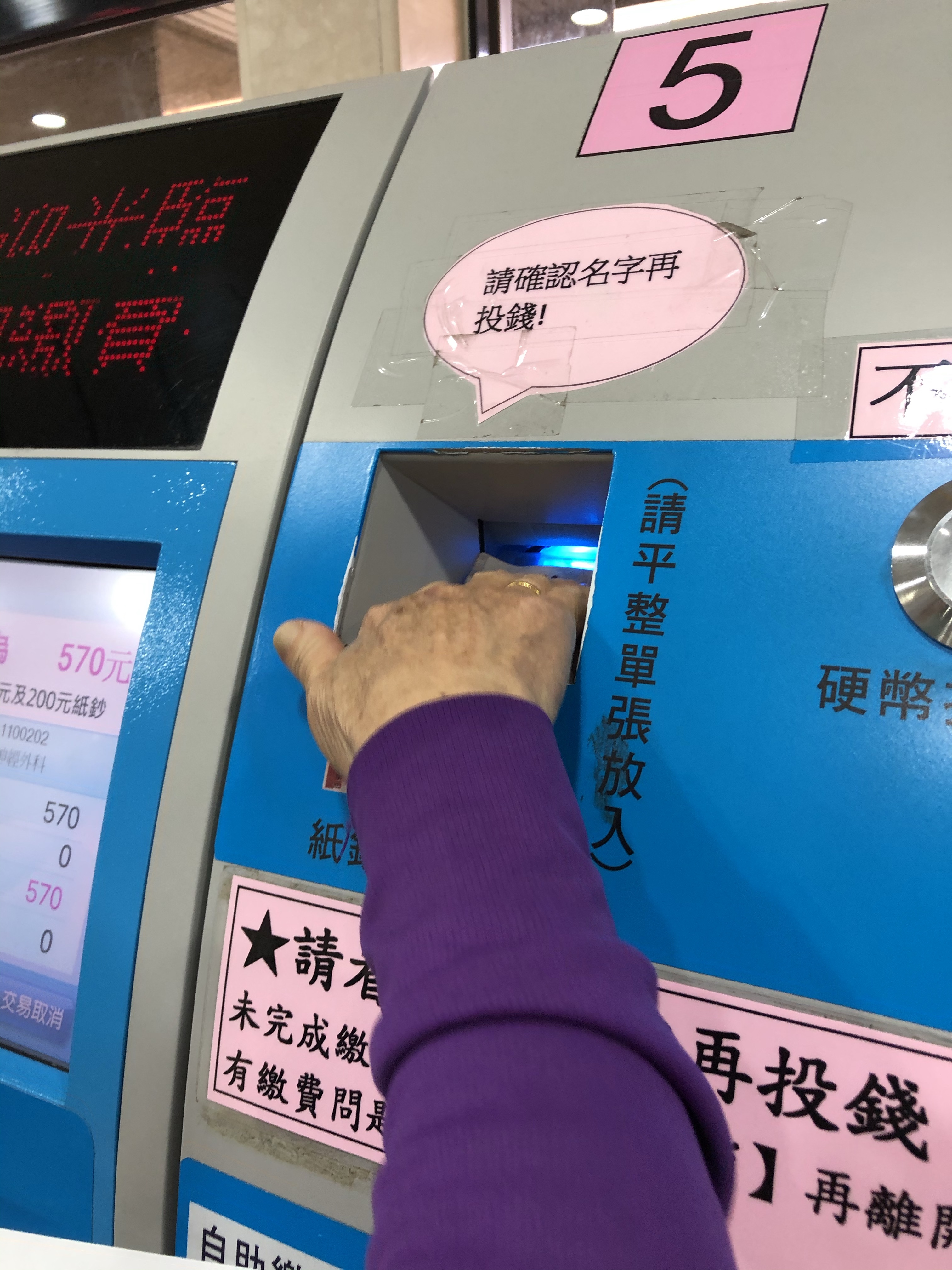
Pay machine—even with cash, which is still the preferred method of the elderly.
Out-of-pocket Costs
Every visit I have accompanied my parents, they receive a bill immediately after the appointment and they can walk the bill to the closest payment machine to pay. If they were in a private clinic, the bill and payments still happen on the spot, because there are no such thing as deductibles and different pricing/discounts for different insurance carriers. There’s one price that all patients pay. That copay can vary but I have not seen a copay exceed the equivalent of US$20 yet and includes the cost of medication.
In the U.S., we would receive a bill months later plus another notice from our health insurance letting us know what we must pay versus covered expenses. One doesn’t actually know what a service costs out of pocket until one or more months later. That just seems completely ridiculous. Plus so much wasted paperwork and paper. Furthermore, if the the visit had lab work or other providers involved, one is billed separately for their services. In Taiwan, all of these are itemized in a single bill including any prescribed medications.
Premiums
The monthly premiums for employed people amount to 5.71% of their salary with some adjustments based on number of dependents and a portion of it may be paid by employers or the government. I would happily and gladly pay this amount of my salary for health insurance that covers everything, including dental, and does not require a high deductibles or obscene copays. Furthermore, the NHI is accepted by both public and private providers, since it is a single payer system. The NHI details the breakdown for different segments of the population here.
Learn More
https://www.vox.com/health-care/2020/1/13/21028702/medicare-for-all-taiwan-health-insurance
 Everyday Dan Bing